New EU Packaging Rules Ahead: Diversified Green Solutions And Our Bamboo Packaging For Overseas Low-carbon Markets
Leave a message
# Industry Compliance Update: Updated EU Design Specifications for Biodegradable Packaging
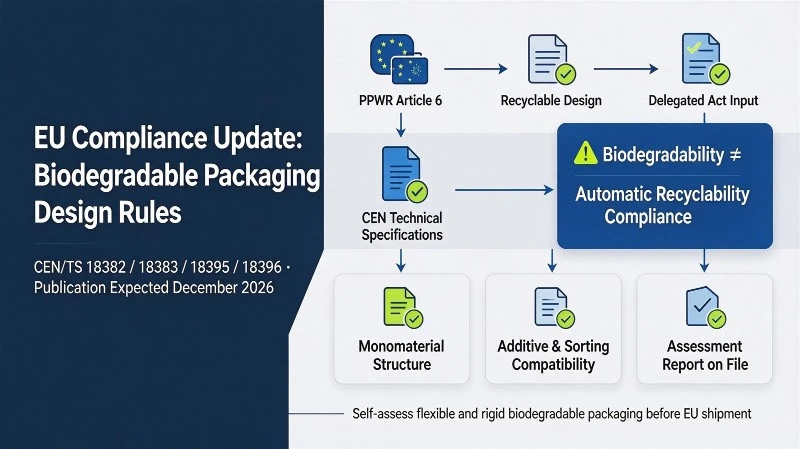
Members of the European Committee for Standardization (CEN) have recently completed voting and formally approved four technical specifications targeting the recyclability design of biodegradable plastic packaging. The reference numbers are CEN/TS 18382 (Guidelines for recyclability design of rigid biodegradable plastic packaging), CEN/TS 18383 (Guidelines for recyclability design of flexible biodegradable plastic packaging), CEN/TS 18395 (Recyclability assessment procedure for rigid biodegradable plastic packaging), and CEN/TS 18396 (Recyclability assessment procedure for flexible biodegradable plastic packaging). The full set of specifications is scheduled for official publication in December 2026.
These documents are CEN Technical Specifications (CEN/TS), serving as dedicated technical guidance to support the recyclable design obligations under Article 6 of the EU Packaging and Packaging Waste Regulation (PPWR). They fill the previous gap in design and evaluation standards for biodegradable packaging and will provide key technical input for the delegated acts of PPWR in the future, directly reshaping the eligibility assessment logic for biodegradable packaging placed on the EU market.
The most fundamental shift brought by this new framework corrects a long-standing industry misunderstanding: biodegradability of a material does not automatically make a product compliant with PPWR recyclability requirements. Under the PPWR regulatory framework, biodegradability and recyclability are two separate evaluation systems and cannot be used interchangeably. Even if a product adopts biodegradable raw materials such as PLA or PBAT, it may still be judged non-recyclable if it adopts an unreasonable structural design, multi-layer lamination mixed with other materials, or contains additives that interfere with sorting and recycling, failing to meet regulatory requirements.
For manufacturers exporting biodegradable plastic bags and biodegradable packaging products to the EU, this means compliance preparations must be upgraded. For new product development and review of existing items, recyclability self-assessment shall be carried out item by item in accordance with the corresponding guidelines for flexible or rigid packaging, covering dimensions including material monomateriality, detachable design, additive selection, marking and labelling, and sorting compatibility. Recyclability assessment reports shall be kept on file for verification by overseas buyers, third-party certification bodies and EU regulatory authorities. Advance assessment and rectification can effectively mitigate risks such as order rejection, cargo detention and non-compliance of EPR registration in the follow-up stage.
# Development Trends of Green Packaging Industry
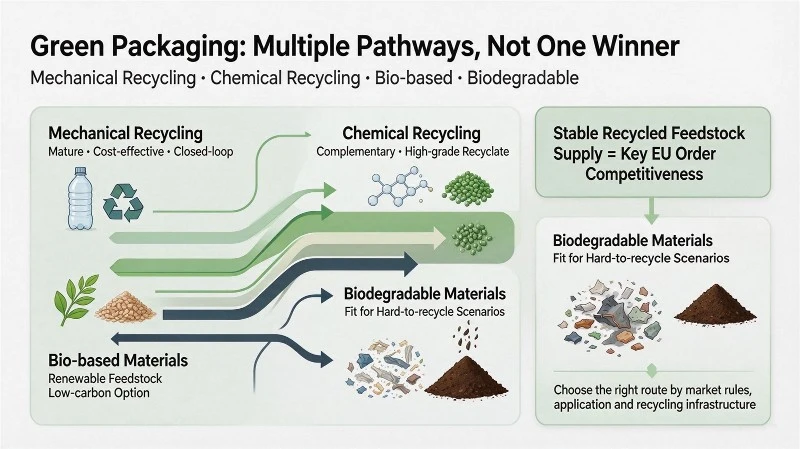
The global green transition of plastic packaging has moved past the pursuit of a single technical route, and formed a landscape featuring parallel development of mechanical recycling, chemical recycling, bio-based materials and biodegradable materials. Each route has its own applicable scenarios and boundaries, and none can fully replace the others. Enterprises shall carry out differentiated product planning according to target market regulations, application scenarios and the maturity of local recycling infrastructure.
Mechanical recycling remains the most mature and cost-effective route for industrialisation. Representative applications include bottle-to-bottle PET recycling and PP non-woven recycling. It boasts outstanding advantages in categories with well-established recycling systems and high standardisation, enabling stable closed-loop recycling. It is suitable for mass, easily collectible and sortable products such as supermarket shopping bags, beverage packaging and general rigid packaging. Chemical recycling acts as a supplementary solution, mainly for contaminated and mixed plastic waste that is difficult to process via mechanical recycling. It converts waste plastics back into monomer feedstock to meet the demand for high-grade recycled materials, though it is currently subject to relatively high barriers in production capacity and cost.
Biodegradable packaging is positioned primarily to fill gaps where recycling systems cannot reach. It fits single-use scenarios where waste is dispersed after use, hard to collect centrally and economically unviable for recycling, such as certain packaging for outdoor food waste and disposable consumables difficult to sort separately. In regions with sound recycling infrastructure, blindly replacing highly recyclable PP and PE packaging with biodegradable materials will disrupt existing plastic sorting lines and downgrade the quality of recycled resin. This is also the core direction advocated by European and American regulators.
For EU foreign trade business, with the phased implementation of mandatory recycled content targets and recyclable design rules under PPWR, stable and traceable supply of recycled feedstock has gradually become a more competitive advantage than simple biodegradability marketing. Overseas brand buyers are attaching growing importance to suppliers' traceability documents for recycled materials, batch stability and carbon footprint data. They prioritise monomaterial recycled plastic packaging compatible with existing recycling systems. When engaging with EU customers, enterprises need to organise the supply chain of recycled materials, maintain material declaration and traceability records to match customers' sustainable procurement targets.
# Dongsheng's R&D Layout for Green Materials (Bamboo Replaces Plastic)
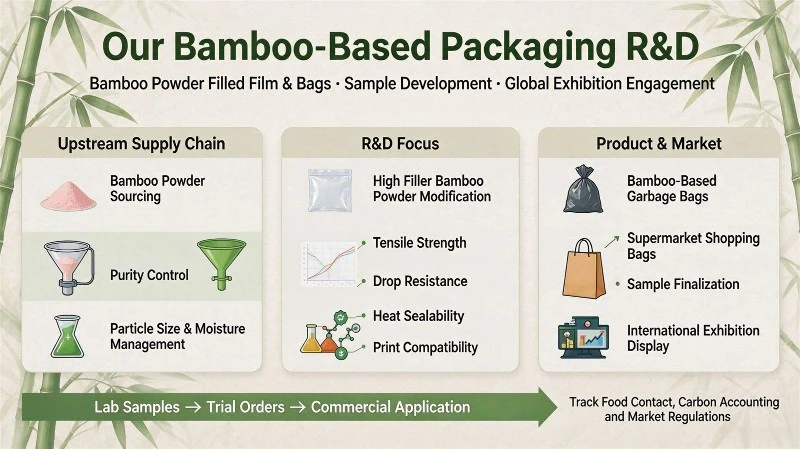
In response to China's national promotion initiative of "Bamboo Replaces Plastic", and aligned with the long-term global demand for plastic reduction and low-carbon packaging, our group continues to invest in the R&D, process iteration and industrial exploration of bamboo-based eco-friendly packaging materials, developing differentiated low-carbon packaging solutions alternative to conventional plastics and ordinary biodegradable materials.
Upstream in the supply chain, we cooperate with core bamboo producing areas in China to build stable sourcing channels for bamboo powder, controlling key indicators including purity, particle size and moisture content of bamboo powder to lay a solid raw material foundation for modified formula development. Our R&D team focuses on tackling technical challenges of high-filler bamboo powder modified film and bag processes. We address difficulties in tensile strength, drop resistance, heat-sealing performance and printability after increasing the filling ratio of bamboo powder, continuously optimising formula systems to balance mechanical performance, production cost and low-carbon attributes.
Our current product portfolio centres on bamboo-based garbage bags and supermarket shopping bags. Multiple rounds of formula sampling, performance testing and sample finalisation have been completed. Leveraging international professional exhibitions such as the Canton Fair, we display samples and discuss technical specifications with global buyers. We collect feedback on mechanical strength, temperature resistance, printing, food contact and compliance certification from customers across different markets to iterate our products continuously.
In the long run, we keep exploring the commercial potential of bamboo-based packaging in overseas markets, and track plastic bans, food contact material regulations and carbon accounting requirements in various countries to complete supporting testing and certification. Bamboo-based packaging serves as a green supplement to our existing PP non-woven and PE packaging lines, providing brand customers with more low-carbon packaging options. Meanwhile, we keep refining production processes to push bamboo-based packaging from the sampling stage towards small-batch trial orders and commercial adoption, and contribute to the diversification of low-carbon alternative solutions for the packaging industry.